

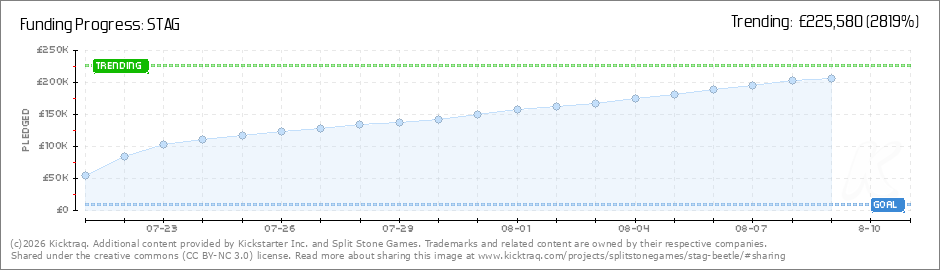
STAG has crossed the line from cute Kickstarter curiosity to real final-48-hours decision. Split Stone Games’ beetle strategy game was still active on Kickstarter when checked on August 9, 2026, and the live trackers agree on the important part: this is not a quiet campaign.
Tabletop Analytics listed GBP204,733 pledged, 3,325 backers, an GBP62 average pledge, and roughly 48 hours left. Kicktraq’s same-window scrape was slightly higher at GBP205,073 and 3,331 backers, against an GBP8,000 goal. The tiny mismatch is normal for live trackers. The useful signal is that both point in the same direction: STAG is funded many times over, still adding backers, and closing on August 11.
That makes it worth covering today. The buyer question is not whether enough people noticed it. They did. The question is whether your table wants a smart-looking nature game that may be more tactical and mean than the lovely beetle art first suggests.
Why STAG Has Heat
STAG has one of those pitches that reads simple and then gets sharper the more you look at it: raise beetles through their life cycle, manage resources, program actions at the same time as everyone else, and eventually decide whether to cooperate or fight when adult beetles meet in a showdown.
The campaign timing helps. A board game with 3,300-plus backers and two days left is exactly the kind of project where tabletop players are making real back-or-wait calls now. It is not a distant prelaunch page, and it is not a campaign that already ended before anyone outside the core audience saw it.
The first-day signal was strong too. Kicktraq’s archived Kickstarter update excerpt says STAG funded in 16 minutes and hit 1,000 backers within the first 18 hours. That does not prove the game is good, but it does show that Split Stone found a crowd quickly.
The cleaner reason to care is the design shape. Tabletopping’s preview describes STAG as a 1-4 player, 60-120 minute game for ages 12+, designed and illustrated by J.J. Neville. Its core is resource management and action programming, with most of each round happening simultaneously.
That simultaneous part matters. Lots of resource games make players wait while everyone optimizes in public. STAG’s pitch is more interesting because the tension begins before the reveal. You commit actions on your own mat, line them up, then see how the round shakes out.
The Actual Table Question
The cute hook is beetles. The actual table question is trust.
Tabletopping’s rules overview says players place action tiles on personal mats, choose action rows, and then resolve those actions left to right. Those actions can introduce grubs, develop insects, age larvae into later forms, draw or tuck cards, collect eggs, trade resources, advance trait tracks, and upgrade action tiles for the rest of the game.
That is already a busier game than the art might imply. The interesting part is that resource income is tied to what your planning covered up. You may build the perfect action order and then discover that the same layout choked off the water, sap, fruit, or other resources you needed.
Cards also seem to be doing real work. A beetle card can become a species you raise, a tucked permanent ability, an income source, or an end-game scoring angle. That gives STAG a nice tactical promise: the same card can be tempting in multiple roles, and the right answer may change as your board develops.
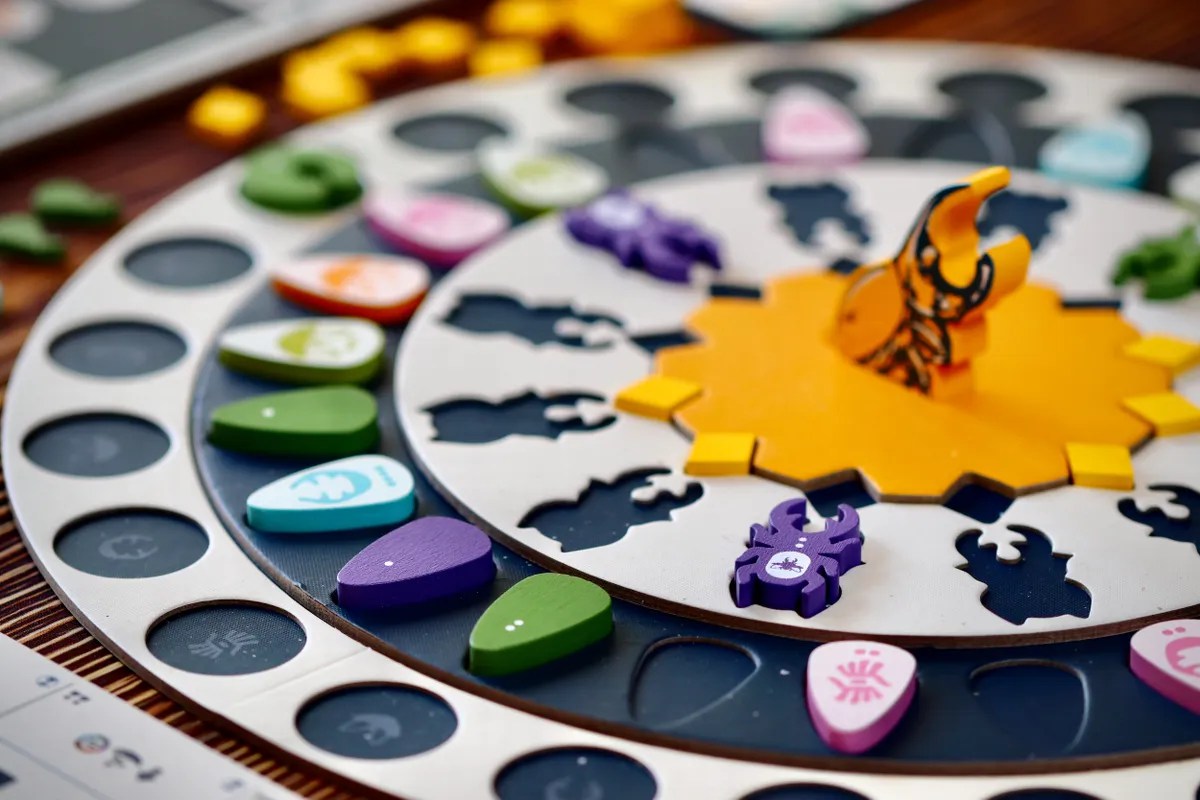
Then come the showdowns. When at least two players have fed adult beetles, each sends one beetle into the center and secretly chooses whether to forage or fight. If everyone forages, points are shared and beetles gain trait progress. If exactly one player fights, that player takes the points. If several players fight, the points vanish and beetles can get punished.
That is the part that will make or break the room. For the right group, it gives a quiet euro-style resource game a nasty little social edge. For the wrong group, it could feel like the game waited until someone built something and then invited the table to kick it.
Back Or Wait?
The strongest reason to back now is that STAG appears to have a distinct identity. It is not just “nature game with pretty art.” The live campaign signal is strong, the rules hook is legible, and the action-programming plus showdown system gives it a sharper promise than the theme alone.
The strongest reason to wait is also practical. This is a crowdfunding buyer watch, not a GameGuideDog review. We have not played a finished copy. Final component quality, shipping, tax, fulfillment pace, and whether the downtime stays low at higher player counts all still matter.
The best fit looks like players who enjoy resource puzzles, simultaneous planning, and a little table-reading pressure. If your group wants gentle nature vibes with minimal conflict, STAG may be more pointed than expected. If your group likes games where a peaceful plan can suddenly turn into a betrayal problem, this is exactly why the final 48 hours are worth watching.
For more tabletop coverage, visit the board-games lane, read our Final Fantasy board-game buyer watch, check the Cult of the Lamb Kickstarter heat, or revisit The Lord of the Rings: Ascension final-week watch.