

Rebirth has a €50 SPIEL Essen bundle with an Essen promo, according to Frosted Games. The useful buying question is whether you want Reiner Knizia’s shared-map tile game after the fair bonus stops mattering. The publisher’s offer applies only at Hall 3, booth 3G300, during the October 22–25 fair and only while supplies last. It is not a general online price or confirmation that copies remain at the counter.
There is a substantial reason to look beyond the promotion: Rebirth is the 2026 Kennerspiel des Jahres winner. That is an established award result, not a new announcement or proof of current sales. The July result is background; the October question is what sort of game, edition and offer a buyer is actually getting.
One tile, several competing priorities
The award body’s description gives a concrete starting point. Players place energy installations, farms and houses on a shared map of Scotland or Ireland, building regions, reaching castles, constructing cathedrals and completing objectives. Each placement scores, and connecting larger regions or fulfilling task cards can change the result.
That makes the map the thing to inspect during a demonstration. Ask the explainer to show a placement that improves your own position, then one that contests an opponent’s opportunity. If those choices are what draw you to tile games, Rebirth deserves a closer look. If you mainly want to build in your own corner without interference, the shared board is a more important warning than any award sticker is a recommendation.
The jury specifically praises the simple underlying rules, tactical possibilities and direct competition. Those are the jury’s judgments, not a GameGuideDog play verdict. They suggest a sensible demo test: does your group enjoy making a small placement decision when several plans depend on the same spaces?
Scotland and Ireland are a buying distinction
Frosted describes a double-sided board with different objectives. Scotland uses secret cathedral missions; Ireland has public goals and bonuses. Do not treat the second map as merely a different illustration. Before buying, ask how the information available to the table changes what you are competing for.
This is useful even if you have no interest in the Essen offer. A buyer comparing tile-laying games can ask whether hidden personal tasks or visible shared targets better suit the group. Rebirth puts that distinction inside one box. It is not evidence that either side will stay interesting for a particular number of sessions; that would require a play-based assessment we do not have.
The player count is less ambiguous: both official listings say two to four. The award body gives 30–60 minutes, while Frosted lists 45–60 minutes. Treat those as published estimates, not a promise about your first teaching game. Age guidance also differs: the jury recommends 10+, while the publisher says 8+. For a younger group, a rules explanation is more useful than silently choosing the lower number.
What the €50 offer does and does not mean
Frosted lists the game plus Essen promo for €50, against its displayed combined reference price of €64.95. Its separate German base-game product page lists €49.95 and was marked sold out when checked. Those are different propositions: the fair bundle adds a promo; it does not establish a major discount on the base game alone. Online stock and booth stock should not be conflated.
The current fair page also says pickup ordering is closed. Do not rely on older pickup-preorder wording on the product page to place a new fair order. Ask about the exact bundle and remaining stock in person; this report does not establish the promo’s complete contents or guarantee availability.
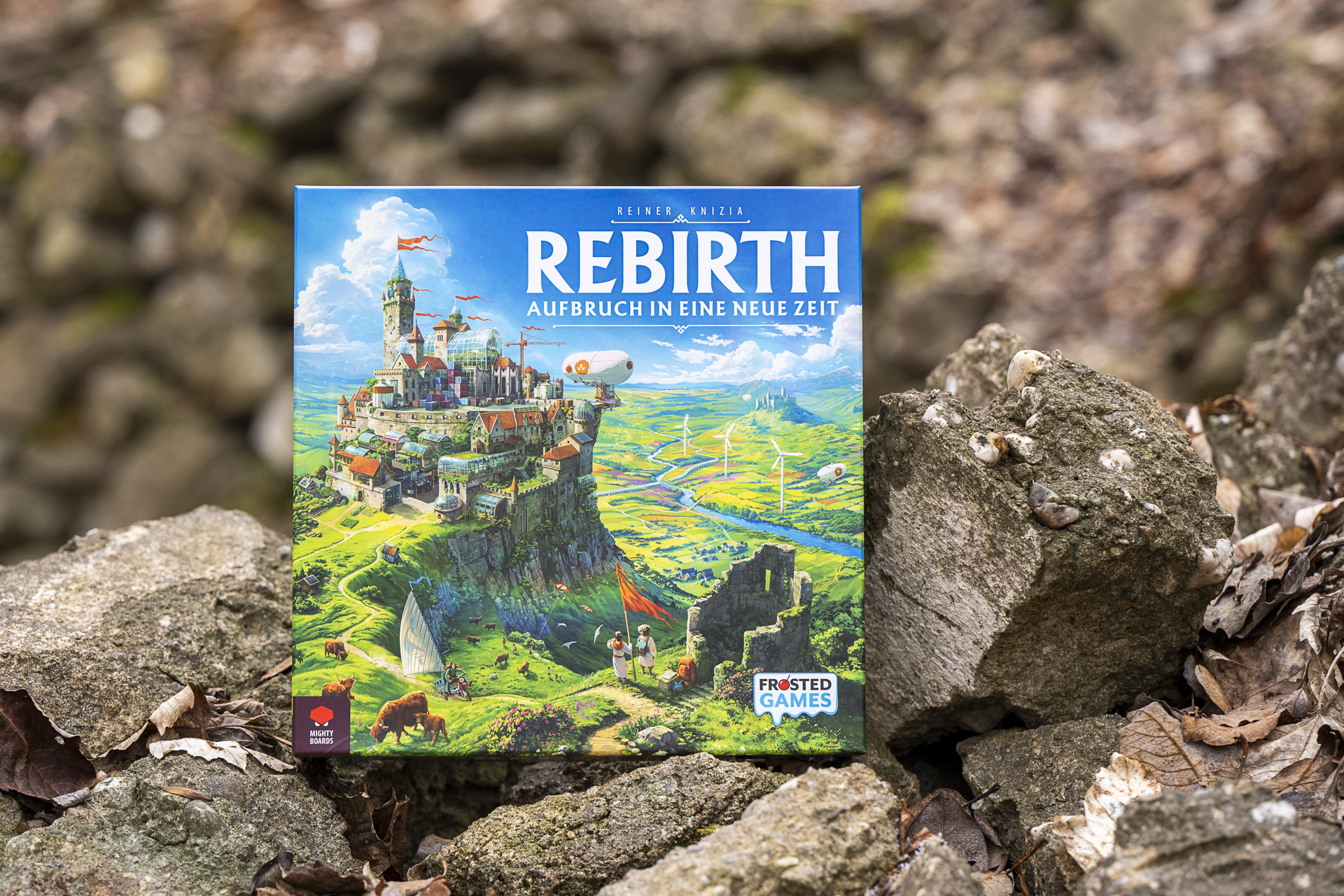
Frosted lists Rebirth for both demonstrations and short pitches. Use that opportunity if you are there. For everyone else, check the language and availability of the edition offered by your seller rather than chasing a booth-only bonus. The pictured box is German; no Polish or U.S. stock or pricing is established here.
GameGuideDog has not played Rebirth. This is reported buyer analysis, not a scored review. The useful shortlist is shared-map competition, two different objective structures and the right edition for your table. For a lighter fair comparison, read Dito’s language-and-promo checks, or browse board games. Buy for the game your group wants to play, with the promo treated as a bonus.