


Blacksmith Master left Early Access on November 19 with a promise that matters to returning players: the developer says all existing Early Access saves work in 1.0. Under that promise, the shop does not need a fresh start. Its next production goals, however, may look different.
The full release adds master workers, siege-machine orders, new item sets, item tiers and random events. Taken together, those announced changes make this more than a reason to reload an old workshop and look for extra recipes. They introduce new requirements for deciding what that workshop should produce next.
This is a reported analysis of the launch announcement, the developer’s detailed preview and the current Steam listing. We have not played 1.0 or tested an imported save. Compatibility is the developer’s statement, not our migration result.
Keeping the save does not freeze progression
The launch announcement explicitly says Early Access saves are compatible and that players do not need to start again. That settles what the developer is promising about continuing an existing shop. It does not establish that every old production plan will be equally useful under the new rules.
The November 18 preview describes items ranging from common to mythic, with more valuable items requiring higher-tier materials. It also introduces events that can reduce customer traffic or lower hiring costs. Our reading is straightforward: a save that loads successfully can still leave its owner with decisions to reassess. That is not evidence of broken saves or lost progress.
For a returning player, the useful question is therefore what the update changes about the shop’s next bottleneck. The official notes give specific answers without requiring a claim that the new economy is better balanced.
Master workers set the next production goals
The developer lists six master-worker types and allows only one of each. Their announced jobs reach beyond another pair of hands on the workshop floor.
The Master Blacksmith unlocks siege-machine orders. The Master Assistant unlocks tier-three smelters, while the Master Scholar opens a fifth blueprint upgrade that raises selling prices again. The Master Miner can find gems. The Master Lumberjack unlocks 80-slot and 150-slot wood storage, and the Master Cashier stops waiting customers from losing patience at the register.
These are distinct reasons to hire, rather than interchangeable staffing upgrades. Storage, smelting and blueprint progression address different limits. Which one should come first in an existing shop is a question for its actual layout and resources; the announcement alone cannot supply an optimal build order.
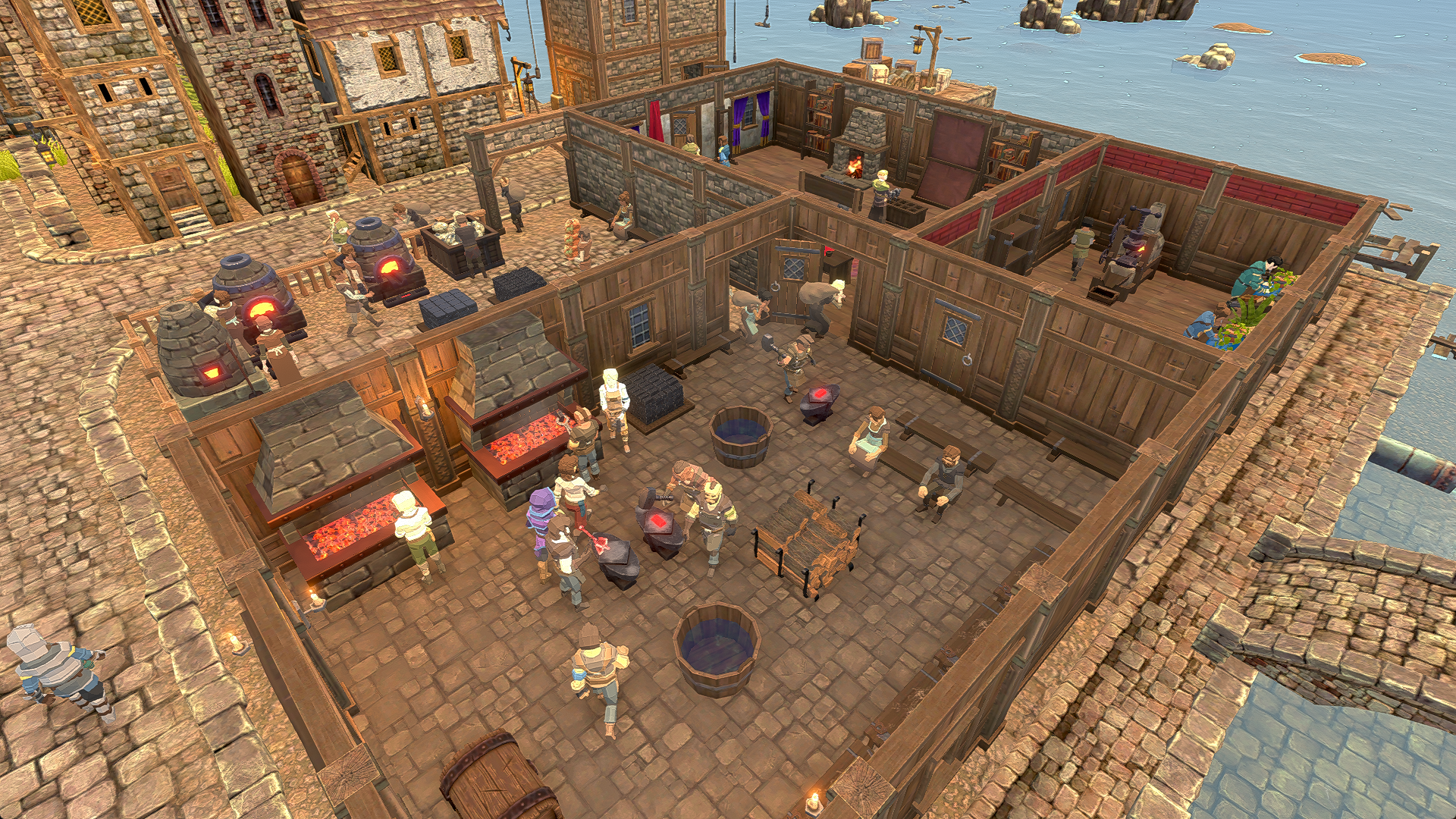
Publisher press screenshot showing a workshop layout; not a tested production-efficiency example. Untitled Studio / Hooded Horse.
The siege branch also connects several additions. According to the preview, completing those large orders rewards mystery blueprints for twelve new three-item sets, or 36 craftable items. Five siege machines are being added. That makes the Master Blacksmith a gate to a further production chain, with more recipes behind it.
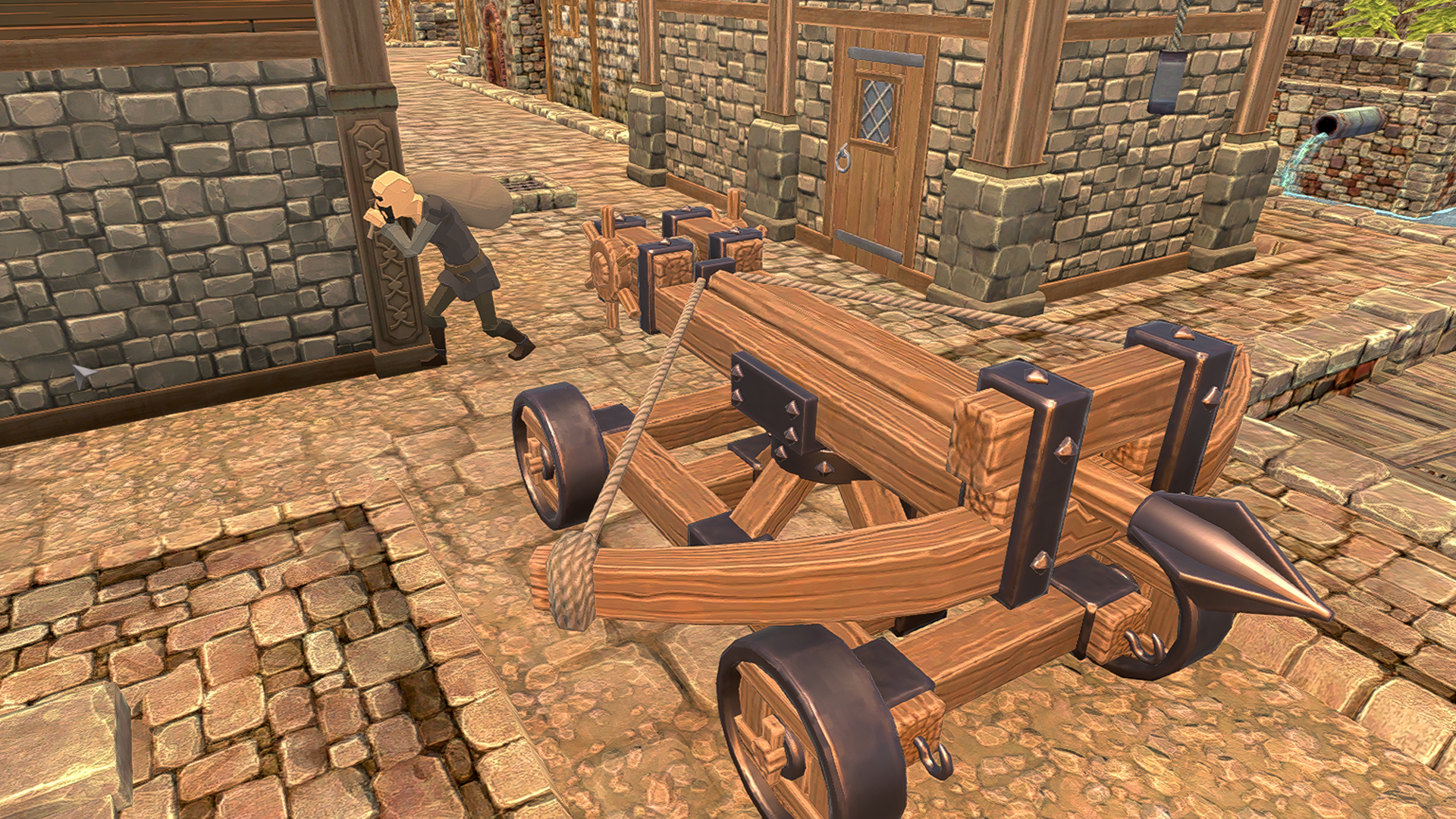
Publisher press screenshot illustrating the siege-equipment theme; not verification of the retail build. Untitled Studio / Hooded Horse.
Read the convenience changes as claims, not benchmarks
The preview also lists six-times speed, customer-only doors and new animations. Its pathfinding changes let NPCs move at arbitrary angles instead of the previous 45-degree increments. The developer describes smoother movement and improved performance.
Those are useful things to check after updating, particularly if a busy shop previously felt awkward to manage. They are not measured improvements in this article. Steam’s platform labels likewise describe availability and support status, not how well a particular machine handles a crowded workshop.
The selected publisher press screenshots illustrate a siege machine and a workshop layout. They are not proof of the current retail interface or of production efficiency.
What the launch offer does, and does not, tell a buyer
At our November 20, 04:16 UTC check, the U.S. Steam listing and its full product API showed $9.99 instead of $19.99, a 50% discount. That is a dated U.S. offer, not a worldwide price or a recommendation to buy. Earlier official posts also advertised 50% sales, so the launch label does not establish a new price low.
Steam’s positive review history needs the same restraint. The game has an Early Access history, and the developer asked for reviews before 1.0. An accumulated storefront rating cannot tell us how the finished release performs on its own. We are not converting that history into a launch verdict.
Our Melvor Idle 2 access analysis makes a related distinction between carrying progress forward and getting every expected feature. For a different management-adjacent fit question, see our Cozy Game Restoration analysis, or browse indie games.
Returning Blacksmith Master players have a clear official reason to revisit their shops: continuity without a required restart, alongside new progression targets. New buyers still need evidence about the resulting pace and balance. The 1.0 announcement explains the intended changes; it does not replace that test.